
Elmore Projected Versus Actual Release
A projected or tentative date points forward. An actual release date records a completed custody event. Idaho uses several fields with narrower meanings, and they must not be merged. A Parole Eligibility Date is not a departure date. A Next Parole Hearing Date is not a promise. A Sentence Satisfaction Date is the sentence endpoint shown by IDOC, subject to lawful calculation changes. Released to Supervision looks backward at a completed move from prison to community supervision.
A pretrial detainee has no sentence-based projected date. Release may depend on bond, a court order, dismissal, another hold, or transfer. The Elmore County Jail warns that processing starts after detention receives bond paperwork or the court order and may take considerable time. A signed order is legal authority, not the exact lobby-exit time.
| Field | What it means | Does it prove release? |
|---|---|---|
| Sentence Satisfaction Date | Displayed IDOC sentence endpoint | No, if still forward-looking |
| Parole Eligibility Date | Earliest possible parole consideration point | No |
| Next Parole Hearing Date | Scheduled Commission process | No |
| Tentative Parole Date | Conditional date after some grants | No |
| Released to Supervision | Recorded prison departure into supervision | Yes, for that IDOC event |
| Discharged | End of IDOC sentence jurisdiction | Confirms sentence completion |
No Universal IDOC Projected Field
The public IDOC Resident/Client Search records examined did not expose a universal field literally named Projected Release Date or Tentative Release Date. This negative finding matters. Idaho’s exact public fields are Sentence Satisfaction Date, Parole Eligibility Date, Next Parole Hearing Date, and Released to Supervision. The Commission, not the general search, uses Tentative Parole Date in some action notices.
IDOC covers state prison residents, people under IDOC parole or probation, and names of former clients who satisfied an IDOC sentence. It does not establish the release date for every ordinary Elmore County jail booking. Its data updates daily and can lag a quick custody change.
The official search form shows the supported name and IDOC-number route.
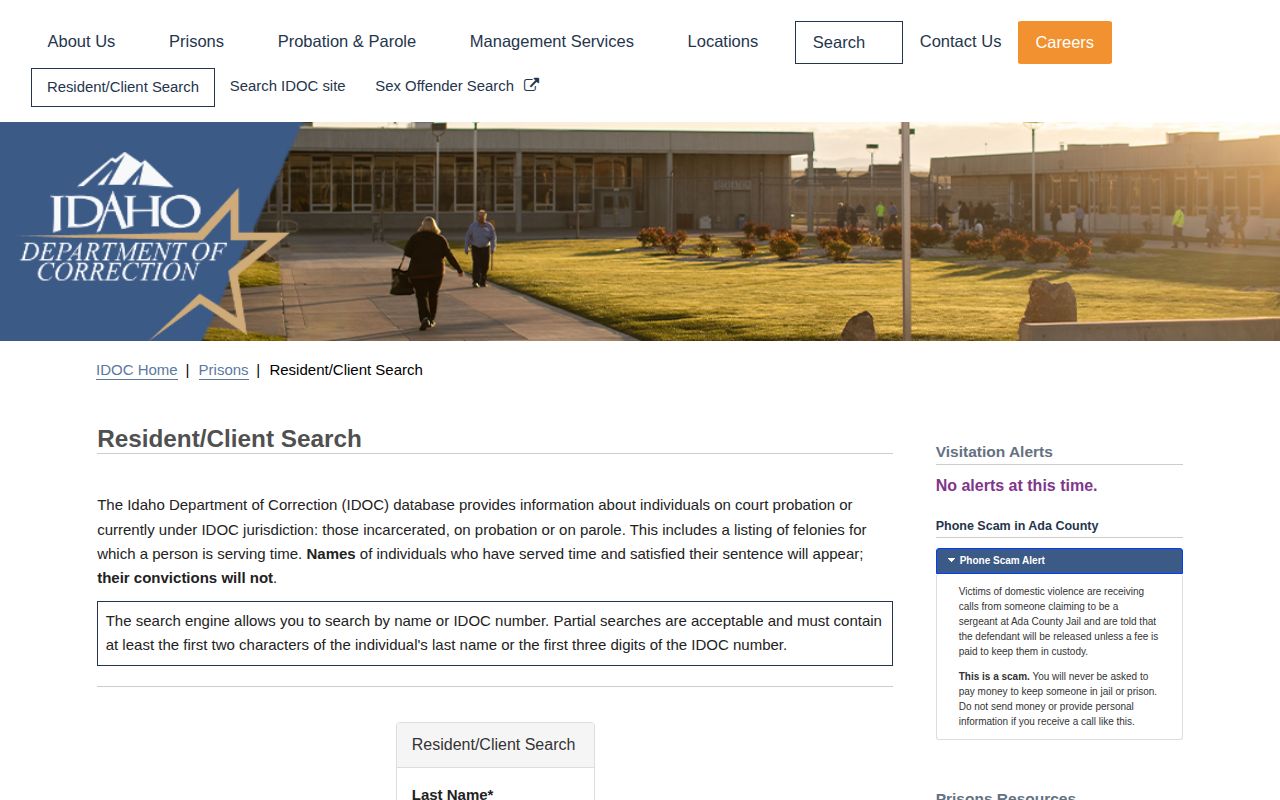
The search is the gateway to the real Idaho fields. It should not be described as a generic projected-date calculator. Always open the full detail record before interpreting a date.
Find an Elmore Release Date
Start with the custodian that holds the person. One system cannot answer for another. The county jail, IDOC, federal Bureau of Prisons, and ICE each publish different records and use different date terms.
- Identify custody. Use Elmore County Jail for a local detention case, IDOC for a state sentence, BOP for a federally sentenced prisoner, or ICE for immigration detention.
- For IDOC, search by last name and optional first name or IDOC number. Open every plausible record and compare identifiers.
- Read the top-level status first. “In custody,” “In community,” and “Discharged” answer different questions.
- Copy the exact date label. Do not rename eligibility, hearing, satisfaction, or supervision dates as one projected date.
- For an Elmore jail sentence, obtain the sentencing order, credited days, and actual jail release record. Do not calculate from the booking date or charge alone.
- When a calculation is disputed, use IDOC Sentencing Records or the sentencing court rather than an informal estimate.
A VINE alert can help confirm a later custody event. The VINE Inmate Check explains person matching and notifications, but VINE is not a permanent sentence-calculation archive.
Elmore IDOC Date Fields
A captured IDOC detail record shows the three forward-looking fields together. The official IDOC example is useful because it prevents a common label error.
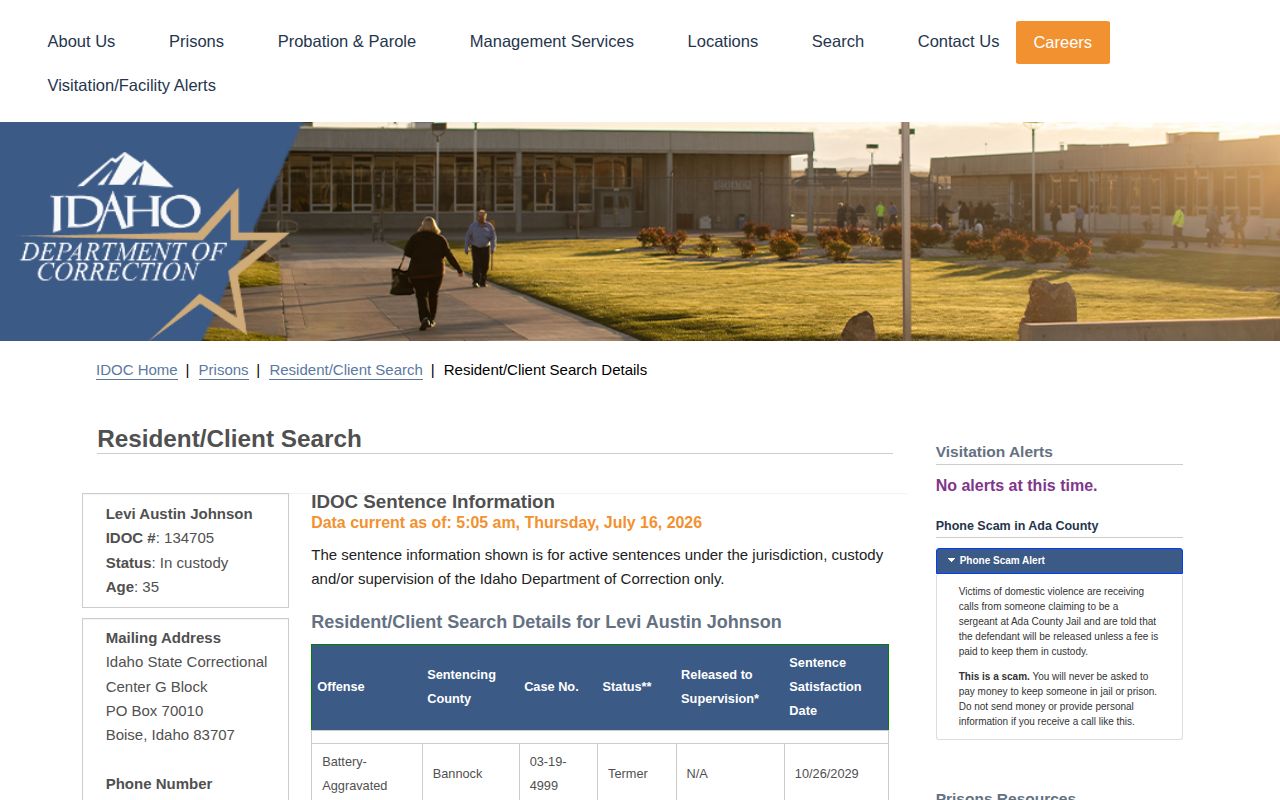
Sentence Satisfaction Date, Parole Eligibility Date, and Next Parole Hearing Date serve different legal and operational roles. None alone confirms that a person walked out of prison.
- Fixed term
- The minimum confinement portion set by the sentencing court.
- Indeterminate term
- The later portion during which parole may be considered.
- Eligibility
- Permission to be considered, not a right to release.
- Detainer
- A request or legal basis for another custodian to hold or receive a person.
Idaho Has No 85% Rule
Idaho does not use a general “serve about 85 percent” rule to compute this state release date. Idaho Code 19-2513 creates a unified felony sentence with a fixed minimum followed by an indeterminate portion. The fixed portion must be served at 100 percent before ordinary parole eligibility. Eligibility still does not guarantee parole.
Ordinary good conduct does not shorten that judicially fixed minimum. The narrow mechanism in Idaho Code 20-101D concerns extraordinary meritorious service, such as exceptional heroism or acts that save lives, prevent major destruction, or stop escape. It is capped, may be withdrawn, and is not routine programming credit.
Rules from another state and federal earned-time provisions do not calculate an Idaho fixed term. Parole authority and eligibility under Idaho Code 20-223 must be read with the judgment and sentence structure. Fixed-life sentences without an indeterminate part do not gain ordinary eligibility through a percentage shortcut.
Note: No researched Elmore County jail-specific good-time formula or weekend early-release rule was found.
Official Elmore Sentence Calculation
IDOC Sentencing Records reviews judgments, calculates sentence endpoints and release eligibility, applies jail and retained-jurisdiction credit, processes parole forfeiture, and maintains official sentence information. It cannot change the sentence imposed by a court.
IDOC Sentencing Records1299 N. Orchard St., Suite 110
Boise, ID 83706
208-658-2000
The official calculation page supplied the following manifest image.
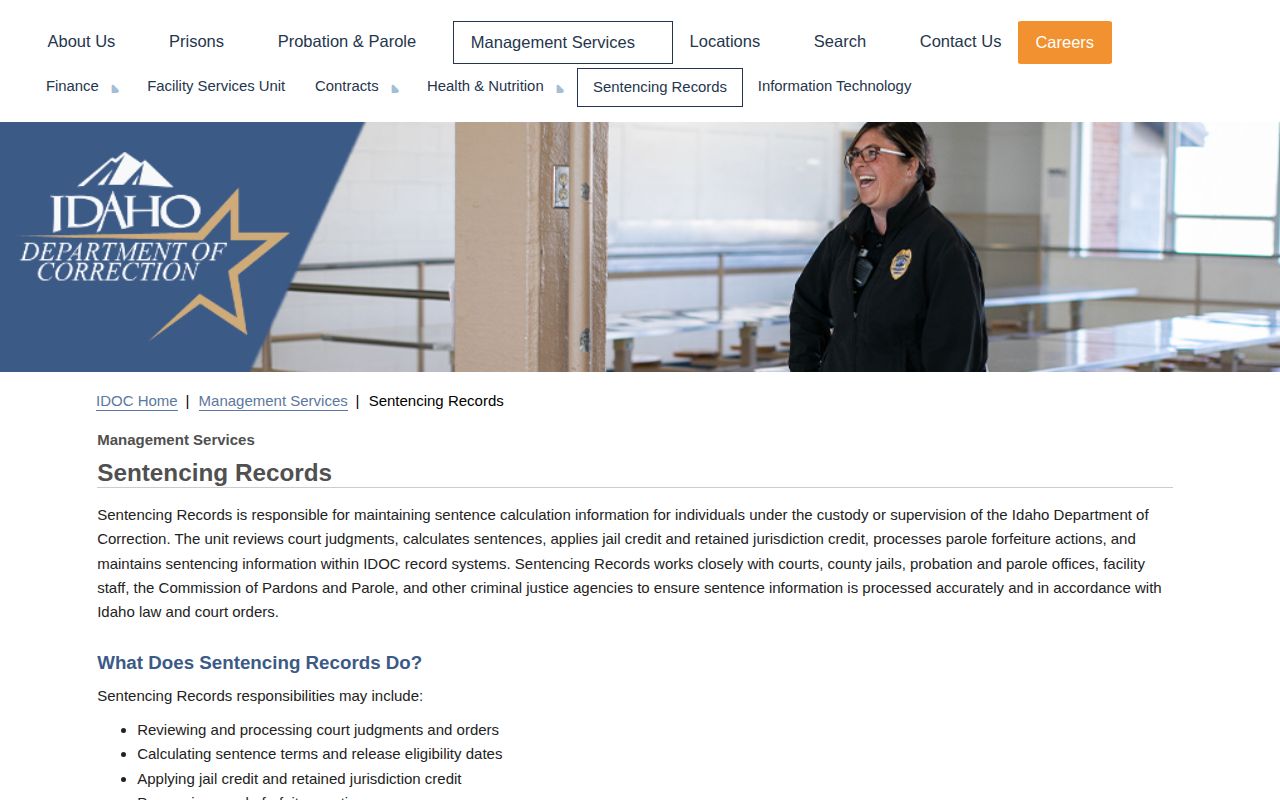
Use IDOC’s Request for Information or public-record route for a suspected error or certified history. A corrected judgment must come through the court process.
Why Elmore Release Dates Change
A displayed date can change for a lawful reason. The change should be traced to an agency record, court order, sentence calculation, or Commission action. Guessing from the original term hides important credits and custody events.
| Factor | Possible effect | Source to verify |
|---|---|---|
| Corrected judgment | Changes the controlling sentence data | Sentencing court and IDOC |
| Jail or retained-jurisdiction credit | Changes credited confinement | IDOC Sentencing Records |
| Consecutive or concurrent terms | Changes the controlling endpoint or eligibility | Judgment and IDOC calculation |
| Parole grant, denial, or revocation | Changes the release path or return to custody | Commission notice and later IDOC status |
| Detainer or transfer order | May send the person to another custodian | Jail, receiving agency, and court record |
| Data correction or daily lag | Changes what the public detail displays | IDOC record and records office |
A Commission grant remains conditional on required programs, paperwork, and an approved parole plan. Recheck after the tentative date for “In community” and Released to Supervision. If the record stays “In custody,” consult the next official notice or IDOC.
Elmore County Jail Dates
A county-jail sentence follows the sentencing order and credited days, not the IDOC parole framework unless the person is under IDOC jurisdiction. For a local release, call the Elmore County Jail at 208-587-9103 for present custody and request the historical record from the Sheriff. Ask for the actual release date and time, release type or authority, and destination or receiving custodian.
The public court docket can show bond, a release order, dismissal, sentence, or probation. It does not prove the exact door-exit time or rule out another hold. The jail record or a source-specific release event confirms completed processing.
Elmore’s jail also has a documented ICE and USMS contract role. A roster disappearance may mean transfer, not community release. BOP’s “Projected Release Date” is federal terminology, while ICE’s locator covers current detainees and recent releases within its own limited window. Keep those findings custodian-specific.
Confirm Elmore Actual Release
For IDOC, “In community” plus Released to Supervision confirms prison departure into active supervision. “Discharged” is the later sentence-completion endpoint. For the county jail, use the jail release record, a VINE release event, and the court chronology. A transfer alert means custody continued elsewhere.
Record the source, exact label, and retrieval date. If legal meaning matters, corroborate the event because release from one custodian can coexist with another hold. The full Elmore County released inmate lookup maps the county, state, federal, immigration, court, and records-request channels.
No-result screens are not proof. A name variation, daily lag, sealed court record, transfer, or the wrong custody system can explain the gap. Use the narrowest official source that owns the date. Save the full date label instead of copying only the number. Then note whether the source describes eligibility, a scheduled hearing, a sentence endpoint, a conditional grant, an actual custody release, or final discharge. This small distinction prevents the most common release-date error.
Public Record Search
Sponsored Results