
No Elmore County 72-Hour Release List Is Published
The Elmore County Sheriff has no verified official page listing jail departures over a rolling three-day period. Its county jail page currently reports that the roster is down and asks users to telephone the jail for current inmate information. No county 72-hour URL, window control, publication cadence, archive, field set, photograph flag, or retention period could be authenticated.
A three-day query remains valid even though there is no feed. It simply requires records matched to the target dates. A county release record can document the actual departure. A court docket can show the order or case event. VINE may supply a custody-change event. IDOC, BOP, or ICE can answer whether another custodian became involved.
The official roster-down notice is the image evidence chosen for this page. It shows why a direct records workflow must replace a feed-based search.
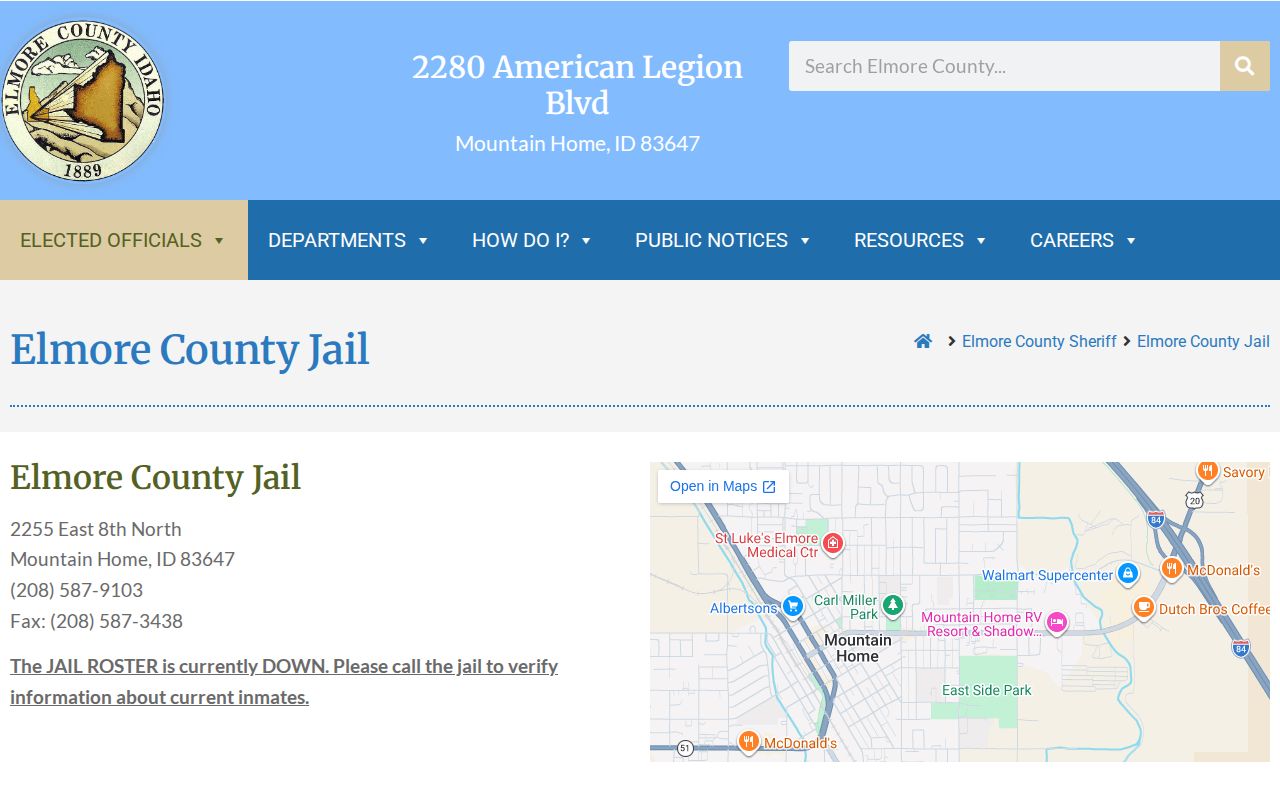
The screenshot confirms the county’s published status, but it contains no list of people released during the prior three days.
How to Check Elmore County 72-Hour Releases
Begin by fixing the date span. Write down the starting and ending dates, the person’s full name and aliases, an approximate booking date, and any known case, booking, or offender number. Then follow a chain that can distinguish release from transfer.
- Call the Elmore County Jail at 208-587-9103 to ask whether the person is presently held there or whether staff can confirm a departure.
- Submit a focused Sheriff request for the booking and release record covering the exact three-day span.
- Search Idaho iCourt as
Last, First, identify the correct Elmore County case, and read the register of actions in date order. - Review a registered VINE event, if available, and separate a release notice from transfer, escape, or facility movement.
- Search IDOC if a felony sentence, parole, probation, or transfer into state jurisdiction is possible.
- Check the federal docket, BOP, or ICE locator when the facts suggest federal or immigration custody.
Use the Elmore County 24-hour release guide when the question is limited to today. The three-day method gives more weight to a dated record and chronology than to real-time pickup planning.
What an Elmore County 72-Hour Release Record Can Show
Because no online county list is available for inspection, the following are request fields rather than claims about a hidden database display. Ask for the smallest set that establishes identity, custody, departure, and destination during the chosen span.
| Requested detail | How it helps a three-day review |
|---|---|
| Name, aliases, and booking number | Connects the event to the intended person and custody episode. |
| Booking date and time | Places admission before the release window and separates repeat bookings. |
| Facility and agency | Identifies which custodian created the departure record. |
| Actual release date and time | Places the recorded exit within or outside the selected 72 hours. |
| Release type or authority | Distinguishes bond, time served, court order, parole, or another basis. |
| Destination or receiving agency | Separates community release from continued custody after transfer. |
Release wording must be read precisely. Bond is release pending further court proceedings. Time served concerns the custodial part recognized by the court but may not end every case or supervision term. A court order applies to the matter it addresses. Transfer means custody continued.
Note: Ask for the actual event fields; Elmore County has not published a web retention period or a standard release-list schema.
Requesting an Elmore County Three-Day Release Record
The Sheriff’s record form permits inspection or copies and provides space to describe the records sought. A useful description names the person and aliases, the approximate booking and release dates, and the exact fields needed: booking sheet, actual release date and time, release type or authority, and destination or receiving agency. Ask for electronic copies if that format is practical.
The Records Office is at 2255 East 8th North, Mountain Home, ID 83647. Its phone is 208-587-3370 extension 1033, fax is 208-587-2118, and email is elmoresheriff@elmorecounty.org. The Sheriff page lists office hours of 8 a.m. to 5 p.m. Monday through Friday.
Public access remains subject to Idaho and federal exemptions. A narrow request may reduce search and redaction work, but it does not guarantee that every requested field will be disclosed. If part is denied, ask for the statutory basis and whether public portions can be separated from exempt material.
This formal route is especially useful after the three-day period has passed. A phone call answers a present-custody question. The written record preserves the agency’s actual release entry and destination in a form that can be compared with the court chronology.
Weekend and Holiday Timing in Elmore County
A three-day span often crosses a weekend or holiday, but Elmore County publishes no special weekend release rule, cutoff, daily release hour, or guaranteed duration. Do not fill that gap with a general jail assumption. The county’s only sourced timing guidance says detention staff start processing after bond paperwork and/or a court release order arrives and that processing can take considerable time.
This means a Friday court action and a later physical exit can both be accurate. The iCourt docket may record when an order was entered. The jail record should supply the actual departure time. A VINE event may add a transmitted custody-change time. Those timestamps represent different stages and should be arranged in order, not treated as contradictions.
If the release was expected but no person appeared, call the jail before drawing a conclusion. Staff may still be processing, another hold may apply, or the departure may have been a transfer. The three-day range is a research frame, not an agency guarantee.
Elmore County Roster Gaps and Release Data Limits
The official site’s roster outage is the most important local data quirk. Absence from an unavailable roster proves nothing. It cannot show whether a person was never booked, remains held, left for the community, moved to another jail, entered IDOC, or transferred into federal or immigration custody.
No post-release retention interval is published for a county feed because no feed was found. VINE provides event notifications rather than a promised historical archive. IDOC says its Resident/Client Search updates daily, but it covers state jurisdiction and not every local bond release. Court records can persist longer, subject to court access rules and shielding, yet they still do not supply the jail door-exit time.
The practical response to a roster gap is not to search more copies of the same missing list. Move to a different kind of evidence: jail confirmation for current status, a Sheriff record for the past event, iCourt for legal authority, and the receiving system for continued custody.
Building an Elmore County Release Chronology
A reliable three-day review can be reduced to a short sequence of dated facts. First comes the last confirmed Elmore County Jail custody point. Next comes the legal event, such as bond posting or a court order. Then comes detention processing and the actual recorded departure. Finally comes the destination or new status.
| Source | Question it answers | What it cannot prove alone |
|---|---|---|
| Elmore County Jail | Current local custody or a recorded local departure | Final outcome of every court case |
| Idaho iCourt | Order, bond, sentence, dismissal, or other case action | The exact time detention staff opened the door |
| Idaho VINE | A transmitted release or transfer event for a selected record | A permanent history or absence of all other holds |
| IDOC search | State custody, community supervision, or discharge status | An ordinary local jail release with no state case |
| BOP or ICE | Status within that federal or immigration system | Freedom from every other custodian |
If two sources appear inconsistent, compare their scope and time. An Elmore County departure and an IDOC In custody result may describe a transfer. A VINE transfer event and a missing jail name can agree. An iCourt dismissal in one case does not eliminate a hold from another matter.
Where an Elmore County Jail Departure May Lead
A community release can follow bond, time served, dismissal, or another court-authorized outcome. Yet Elmore County Jail also sends people to other custodians. A sentenced felony matter may lead to IDOC. An out-of-county warrant may lead to another sheriff. The jail also has a documented relationship with USMS and ICE.
For IDOC, inspect the top-level status. “In custody” is not release. “In community” means the person is outside prison under supervision, often with Released to Supervision details. “Discharged” marks the later satisfaction of the state sentence. These state labels should not be imported into an ordinary Elmore County bond record.
BOP is appropriate for federally sentenced prisoners, while a federal pretrial matter calls for the federal docket and USMS inquiry. ICE ODLS has limited coverage for current and recently released immigration detainees, so a plausible immigration transfer should be checked promptly. A three-day county review is complete only when the destination meaning is understood.
Confirming One Elmore County Release Across Three Days
When the goal is one named person rather than a list, identity checks are as important as dates. In iCourt, use Last, First and compare the case number, location, charge degree, and year of birth. In IDOC, open every plausible record because one person can have more than one IDOC number. In all systems, avoid relying on a name alone.
The full Elmore County released-inmate lookup explains the named-person search across local, state, and federal scopes. For a 72-hour review, retain the narrow dates and record each source’s exact label. “Release,” “transfer,” “In community,” “Discharged,” and “Not in BOP Custody” answer different questions.
The best conclusion states its limits. For example, a Sheriff record may establish departure from Elmore County Jail and name IDOC as the receiving agency. It should not be shortened to “released” if the person remained in custody. Clear scope is what makes a three-day chronology useful.
Public Record Search
Sponsored Results