
Elmore Parole and Probation
Idaho divides release decisions from field supervision. The Idaho Commission of Pardons and Parole holds hearings and may grant, deny, revoke, reinstate, schedule, or continue parole. The Idaho Department of Correction, or IDOC, supervises people in the community. Elmore County Justice Services handles a separate group of local adult misdemeanor probation cases.
Parole is conditional release from an IDOC prison sentence during the indeterminate part of that sentence. Probation is court-ordered supervision in the community. It may begin without a prison term. Neither label means the sentence is finished. An unsupervised bond release from the Elmore County Jail is not parole or probation unless a court or correctional record separately creates supervision.
| Record type | Who acts | Best public check |
|---|---|---|
| Parole | Commission decides; IDOC supervises | IDOC Resident/Client Search and Commission notice |
| State probation | Court orders; IDOC supervises | IDOC Resident/Client Search and court docket |
| Adult misdemeanor probation | Elmore County Justice Services | County office and iCourt case |
| Bond release | Court and jail process release | Jail release record, VINE event, and court docket |
- Parole
- Conditional community release from a prison sentence.
- Probation
- Court-ordered community supervision, sometimes imposed instead of prison.
- Discharge
- The recorded end of correctional sentence jurisdiction.
- Absconder
- A supervised person alleged to have stopped reporting or left supervision without authorization.
Verify Elmore Post-Release Supervision
The IDOC Resident/Client Search covers incarcerated residents, people on IDOC parole or probation, and retained names of people who satisfied an IDOC sentence. It updates daily, so a fast change can lag. Search results should be matched with identifiers, not name alone.
- Search by last name and optional first name, or use an IDOC number. Partial searches require at least two last-name letters or three IDOC digits.
- Open each plausible detail record and compare the identifying data. Read the top-level status before relying on a sentence row.
- Look for “In community,” the Parole or Probation label, Released to Supervision, and the listed district, officer, or office phone.
- Use the live assignment shown in the record. If it needs confirmation, contact that office rather than assuming every Elmore case belongs to Mountain Home.
- For a misdemeanor case outside IDOC, read the iCourt docket and contact Elmore County Adult Misdemeanor Probation.
A real IDOC example shows how “In community,” Released to Supervision, and a supervising office appear together. The official IDOC detail record is the source for this captured layout.
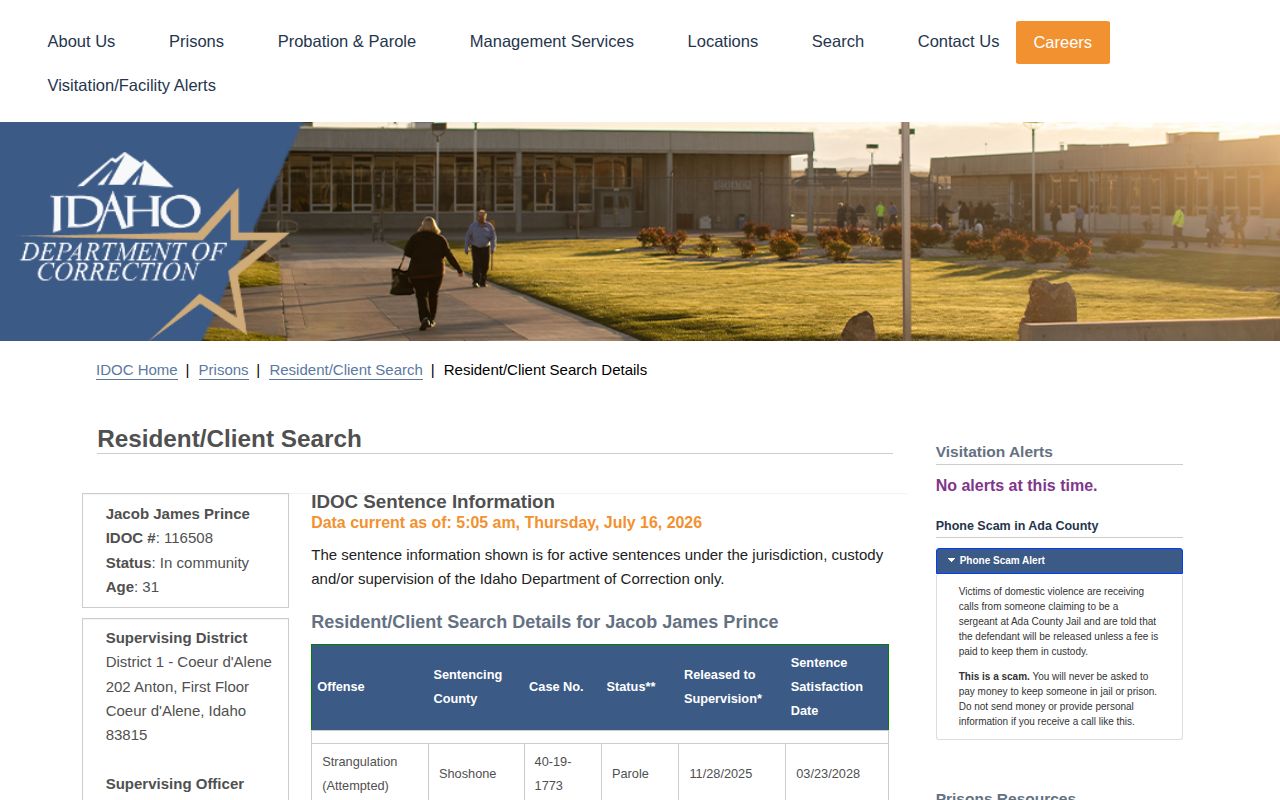
The image demonstrates the field relationship, not a promise that every record exposes identical details or updates at the same moment.
Elmore State Supervision Office
Elmore County is in IDOC District 4, which follows Idaho’s Fourth Judicial District and also serves Ada, Boise, and Valley counties. The Mountain Home satellite is the local state-supervision office. A person’s current IDOC detail remains the best first source because assignments may change.
IDOC District 4, Mountain Home Satellite240 North 4th East
P.O. Box 127
Mountain Home, ID 83647
208-587-8170
The district’s official page shows the local office and broader district structure. The District 4 office page supplied this Elmore County supervision image.
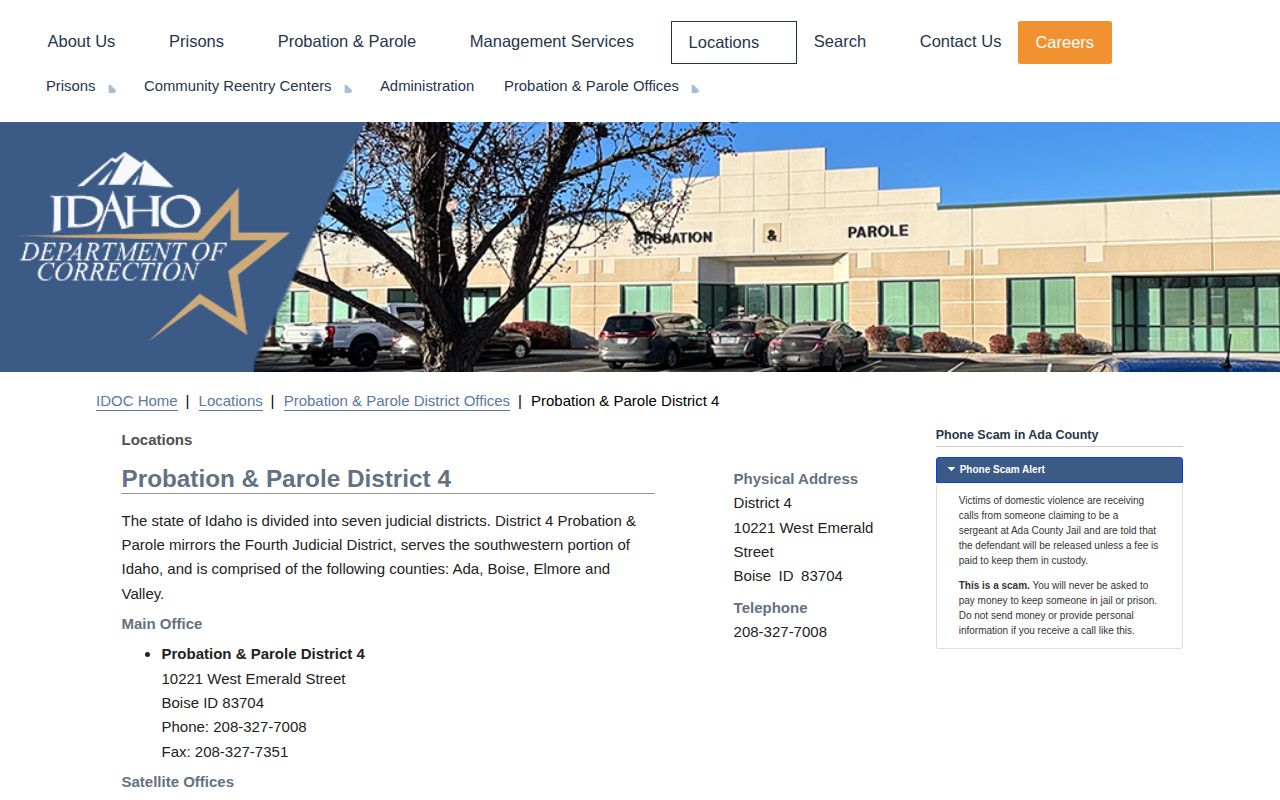
This office is for IDOC clients. It should not replace County Justice Services for an adult misdemeanor probation case.
Elmore Parole Decisions and Dates
The Commission’s hearing record answers whether parole was considered and what action was taken. Its hearing schedule covers current sessions. Incarcerated participants attend virtually, while public supporters use the Boise attendance location. Supporter testimony requires advance notice. Dates and hearing order can change.
The Notice of Action Taken index generally posts decisions after hearings. A Grant Parole entry is prospective. Any stated parole date remains tentative. Required programming, paperwork, and an approved parole plan must be complete, and no one is released before the stated date.
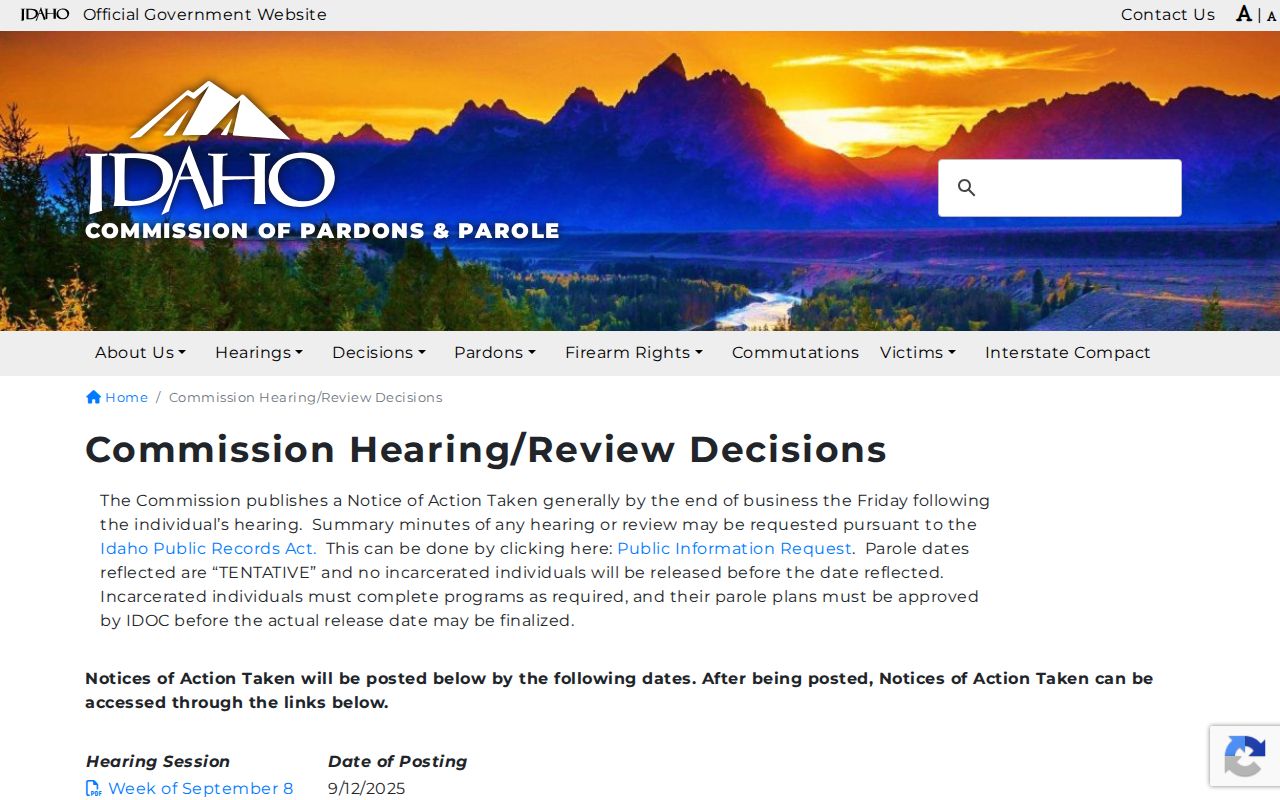
The captured warning is why a decision notice must be followed by the later IDOC status. “In community” with Released to Supervision is stronger evidence of actual prison departure.
Elmore Misdemeanor Probation Split
Elmore has two local supervision paths. State felony probation and parole generally run through IDOC. Elmore County Justice Services separately operates Adult Misdemeanor Probation. Sending every released person to state parole would be wrong.
Adult Misdemeanor Probation150 S. 4th E., Suite 5
Mountain Home, ID 83647
208-587-2130
The county also lists Adult Drug and DUI Court separately at another location. A specialty-court contact does not prove that a person is assigned to misdemeanor probation. Start with the case docket and current office record.
The official Justice Services page distinguishes these programs and supplied the local reference below.
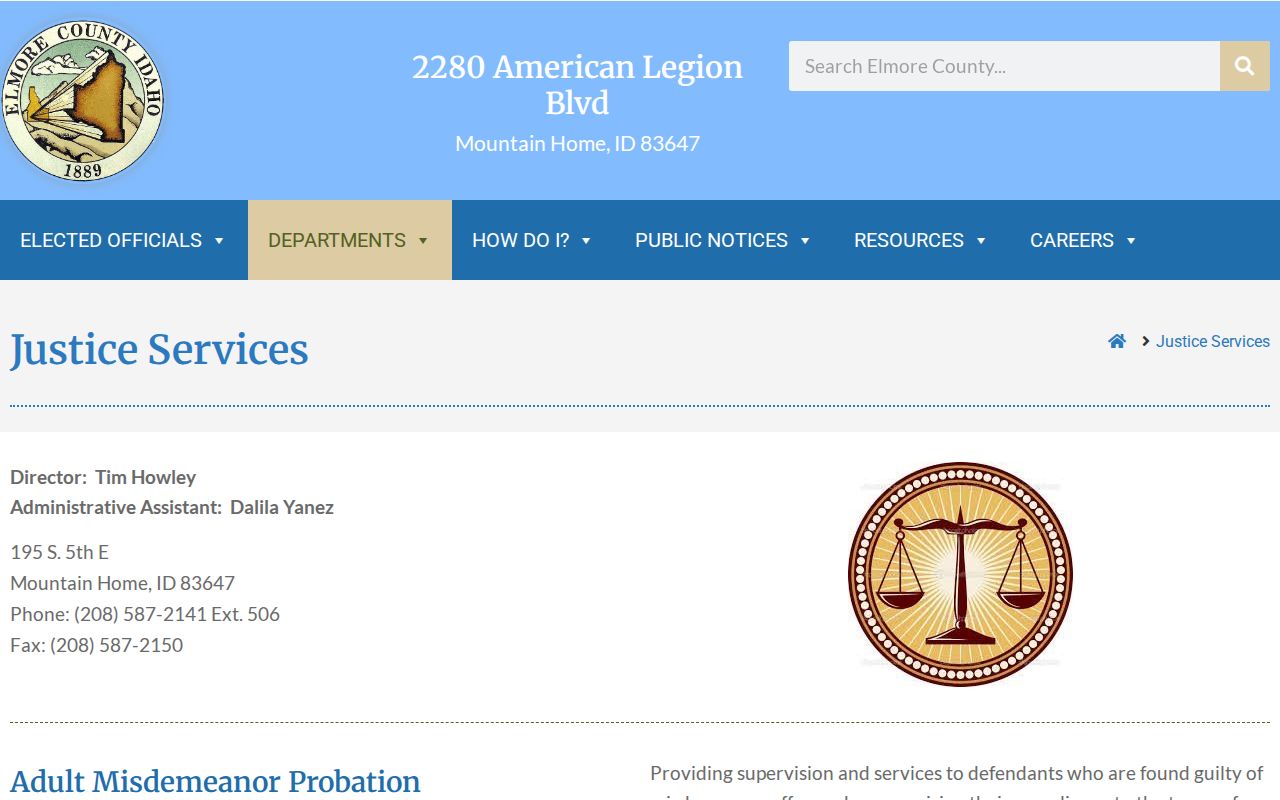
That distinction is central to accurate Elmore County post-release supervision verification.
Elmore Supervision Violations
Conditions are rules attached to community supervision. Their exact terms come from the court, Commission action, and IDOC plan. A violation allegation may lead to modification, arrest, revocation proceedings, or return to custody. It does not by itself establish a final outcome.
An absconder may remain legally under supervision even when not reporting. Research found no official public Elmore County or IDOC absconder list. Do not treat “In community” as proof of good standing. The supervising office may confirm only what law and agency policy permit. A court docket can add context if an alleged violation led to a new case, warrant, or hearing, but the docket should be read in order. An allegation, filing, and final ruling are not the same event. When immediate custody status matters, check the agency that could hold the person and use VINE as a notice channel.
Idaho VINE can send custody movement alerts, but it is not a supervision-compliance system. A transfer event means custody continued elsewhere. A release event concerns the participating custody record and does not prove that parole or probation ended.
Elmore Release Property and ID
Property and identification create two practical Elmore County issues after custody. The Elmore County Jail says property may go to family or friends only after the incarcerated person signs a property-release form. Deputies release it only to the named recipient, who must show positive identification. This rule concerns property released while the person remains in custody. It should not be read as a full end-of-custody property policy.
Separately, Sheriff Support Services issues identification cards at 125 South 5th East in Mountain Home. Published hours are 8:30 a.m. to 4 p.m. on weekdays, excluding holidays. The county says Glenns Ferry issuance is temporarily unavailable. Confirm the service before travel because that detail may change.
Elmore Supervision Discharge
“In community” means a person has left IDOC prison custody and remains under correctional jurisdiction. “Discharged” is the later endpoint. A Sentence Satisfaction Date may be forward-looking until completed, while a displayed Discharged date records that IDOC sentence status.
For state supervision, preserve the IDOC status and date, then use IDOC Sentencing Records if the calculation or certified history is disputed. For county misdemeanor probation, use the court docket and Justice Services. The broader Elmore County released inmate search explains how jail, court, VINE, federal, and immigration sources answer other custody questions.
Records can change after a revocation, corrected judgment, or new custody event. Verify the current agency record before describing supervision as complete. Keep the date and exact label from each source. A Commission notice can document the decision, IDOC can document active community supervision, and a later discharge can document the endpoint. Those records form a sequence. Substituting one for another can turn a pending release into a false claim of actual departure or turn active supervision into a false claim that the sentence ended.
Public Record Search
Sponsored Results